


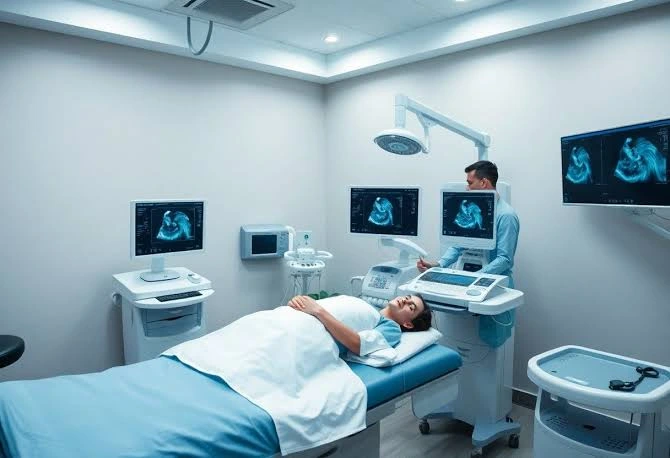
Unlike general medical facilities that offer imaging as one of many services, ultrasound clinics dedicate their resources entirely to this field. These clinics focus exclusively on diagnostic imaging, offering a broader range of ultrasound types, including thyroid, pelvic, carotid, general, and testicular. Patients benefit from greater diagnostic accuracy, and they may experience more personalized care. Here is more information on ultrasounds:
What Is an Ultrasound Clinic?
An ultrasound clinic is a medical facility that provides diagnostic imaging services using ultrasound technology, and its environment is designed specifically for imaging patients. Staff at these clinics are trained sonographers, professionals who specialize in operating ultrasound equipment and capturing diagnostic-quality images. Their training goes deeper than the general imaging knowledge a technician at a multi-service clinic may have. Patients receive care from individuals whose entire professional focus is ultrasound.
What Services Do They Provide?
Specialized ultrasound clinics offer a broad range of diagnostic imaging services for patients across different health needs. These services help physicians identify conditions affecting organs, tissues, blood vessels, and more. The range of services available makes these clinics a practical choice for many types of medical investigations. Common services include:
- Diagnostic imaging consultations, where sonographers perform scans and radiologists analyze the results
- Follow-up imaging, used to monitor known conditions or track changes over time
- Referral-based assessments, ordered by a physician to investigate a specific concern or symptom
What Are the Ultrasound Types?
Several distinct ultrasound scans are performed at specialized clinics, each targeting a different body area to support precise diagnostic investigations. For the upper body and neck, thyroid ultrasounds evaluate the thyroid gland for nodules, cysts, or structural changes, while carotid ultrasounds assess blood flow in the carotid arteries to detect blockages that increase stroke risk. General ultrasounds examine internal organs such as the liver, gallbladder, kidneys, spleen, and pancreas to identify abnormalities or underlying disease.
Other specialized procedures focus on pelvic and reproductive health. Pelvic ultrasounds evaluate the reproductive organs and surrounding structures, while testicular ultrasounds investigate pain, swelling, or masses. Each scan type requires specific patient preparation, positioning, and technical expertise. Specialized clinics are equipped with the precise instrumentation and clinical knowledge, enabling healthcare professionals to conduct diagnostic assessments accurately and efficiently.
How Is Specialized Care Beneficial?
Choosing a specialized ultrasound clinic over a general medical facility offers several practical advantages. Dedicated clinics invest in advanced ultrasound equipment, and this supports clearer imaging and more precise results. Patients benefit from targeted care, as image quality influences diagnostic accuracy.
Sonographers at specialized clinics perform ultrasound scans as their primary focus, which builds a high level of procedural expertise over time. This specialization helps reduce the likelihood of errors, and it supports more consistent outcomes across different scan types. For patients managing ongoing conditions, this consistency is valuable.
Meet Your Imaging Needs Today
Specialized ultrasound clinics provide focused, high-quality diagnostic imaging services that support accurate medical decisions. These clinics are equipped to handle a wide range of imaging needs with precision and efficiency; their dedicated teams, advanced equipment, and streamlined processes make them a reliable choice for patients seeking clarity on their health. If you or your physician has identified a need for ultrasound imaging, contact a specialized ultrasound clinic to book your appointment today.
